
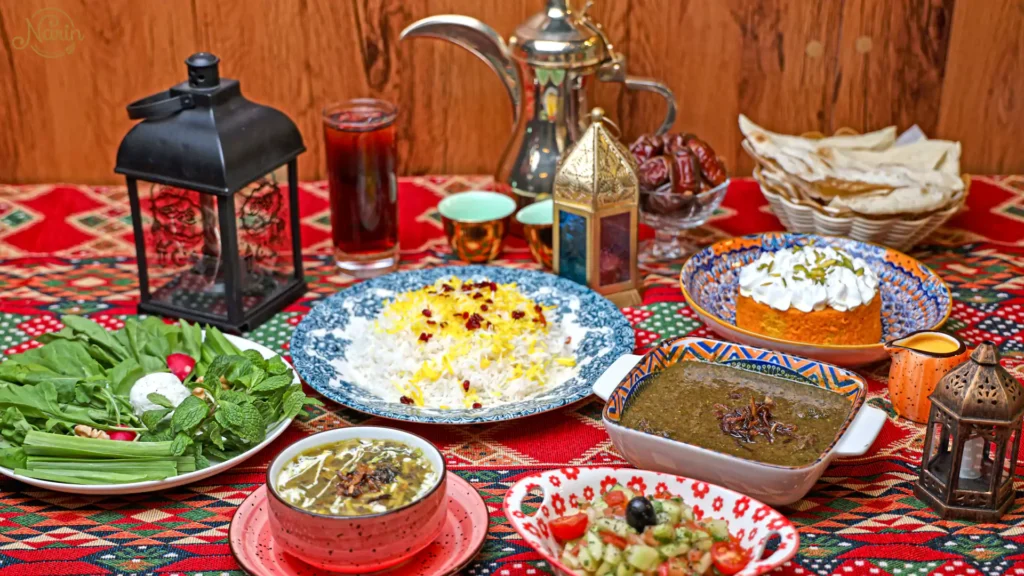
Open the stew section of a Persian menu and the names may not give much away. Ghormeh Sabzi is dark, herby and sharpened with dried lime. Fesenjoon is thick with walnuts and pomegranate. Gheimeh takes a more familiar route through lamb, tomato and yellow split peas, then adds its own Persian accent.
For a first order, start with what you already enjoy. Choose Ghormeh Sabzi for a herb-forward, tangy dish; Fesenjoon for a dense, nutty sauce with sweet-sour notes; or Gheimeh for a tomato-based stew with a more familiar savoury profile. This guide explains what goes into each Persian stew, how it tastes and what to order at a Persian restaurant in Sydney.
What is a Persian stew?
A Persian stew, called “khoresh” or “khoresht”, is a slow-cooked dish served with rice. Meat, legumes, herbs, fruit, nuts, or vegetables simmer together until the cooking liquid becomes a sauce. Each stew has a clear foundation: sautéed herbs shape Ghormeh Sabzi, ground walnuts and pomegranate define Fesenjoon, while yellow split peas and tomato form the base of Gheimeh.
The English word “stew” is the closest translation, though it does not tell the full story. A khoresh is generally spooned over chelow, the plain steamed rice served with many Iranian dishes, or eaten beside saffron rice. The sauce needs enough body to cling to the rice without becoming dry or pasty.
Persian stew is not the same as soup, ash or abgoosht. Ash is a thick category of soup that may contain herbs, legumes, noodles or grains. Abgoosht has its own ingredients and serving method. If a Sydney menu lists “Stews & Khoresht”, it is pointing to the rice-based dishes that many Iranian families would recognise as khoresh.
Ghormeh Sabzi, Fesenjoon and Gheimeh at a glance
The difference between Ghormeh Sabzi, Fesenjoon and Gheimeh begins with the sauce. The table below gives first-time diners a practical picture of each dish before they order.
| Persian stew | Main ingredients | Dominant flavour | Texture | A good fit if you like |
| Ghormeh Sabzi | Sautéed herbs, beans, lamb and dried lime | Herbaceous, savoury and tangy | Thick with chopped herbs and beans | Herb-heavy dishes and tart flavours |
| Fesenjoon | Ground walnuts, pomegranate molasses and chicken | Tart, sweet-sour or mildly sweet | Dense, smooth and nutty | Pomegranate, walnuts and fruit with meat |
| Gheimeh | Yellow split peas, lamb, tomato and dried lime | Savoury, tomato-led and tangy | Saucy with distinct split peas | Tomato-based stews and legumes |
| Gheimeh Bademjan | Gheimeh-style sauce with eggplant | Savoury and tangy with a softer vegetable note | Soft, layered and substantial | Eggplant and tomato-based dishes |
These flavour descriptions are guides, not fixed recipes. The pomegranate molasses can pull Fesenjoon towards tart or sweet. Dried lime changes the sharpness of Gheimeh. Herb blends for Ghormeh Sabzi vary between Iranian regions and family kitchens. Asking how a restaurant cooks its version is more useful than assuming every bowl will taste the same.
Ghormeh Sabzi: a herb and dried lime stew
Ghormeh Sabzi is made with a finely chopped herb mixture, beans, meat and dried Persian lime, known as limoo amani. Parsley, coriander, chives or spring onion and fenugreek appear in many recipes. The exact blend changes, but fenugreek gives the stew much of its distinctive aroma. The herbs are sautéed before the long simmer, which accounts for the deep green colour.
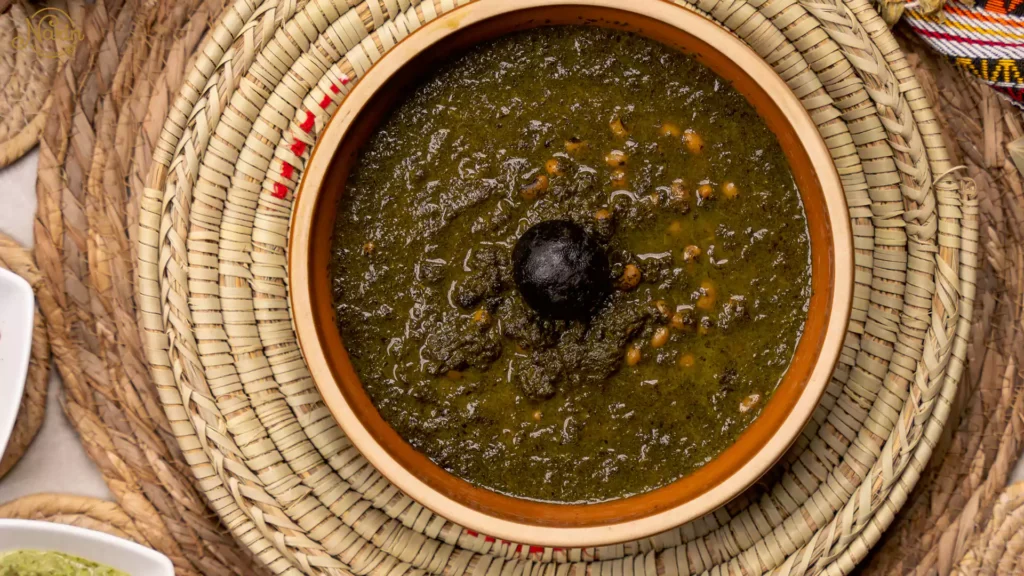
The first spoonful of Ghormeh Sabzi is earthy and savoury rather than fresh and grassy. Sautéing changes the herbs, while dried lime brings a musky citrus tang and a faint bitter edge. Beans add body and the meat softens during cooking. Chilli is not the main source of flavour, so a well-balanced version can be aromatic without being hot.
Dark colour alone does not prove that Ghormeh Sabzi has been cooked well. Herbs taken too far in the pan can taste burnt or bitter. A well-made stew should have integrated herbs rather than a raw green flavour, tender meat, cooked beans that still hold their shape and enough sauce to work through the rice. Dried lime should sharpen the dish without dominating every bite.
Who is Ghormeh Sabzi suited to?
Ghormeh Sabzi is a strong first choice for diners who enjoy herbs, legumes and tart food. It has less tomato flavour than Gheimeh and none of the sweet-sour walnut character of Fesenjoon. Someone who likes herb-based sauces, slow-cooked lamb or the citrus bitterness of preserved ingredients will find familiar points of reference.
Narin’s current Ghormeh Sabzi combines lean lamb, chopped herbs, red kidney beans, dried lime and spices, served with saffron rice. That detail matters because the bean and meat can differ from one Persian restaurant to another. Some family recipes use beef or a different bean, so the dish name does not describe every ingredient on its own.
Fesenjoon: walnut and pomegranate with a sweet-sour range
Fesenjoon, also written as Fesenjan, is a Persian walnut and pomegranate stew. Ground walnuts cook slowly into the liquid, releasing their natural oil and thickening the sauce. Pomegranate molasses brings acidity, fruitiness, sweetness and a slight tannic quality. Chicken is common in restaurant versions, while Iranian recipes may use duck, meatballs or other proteins.
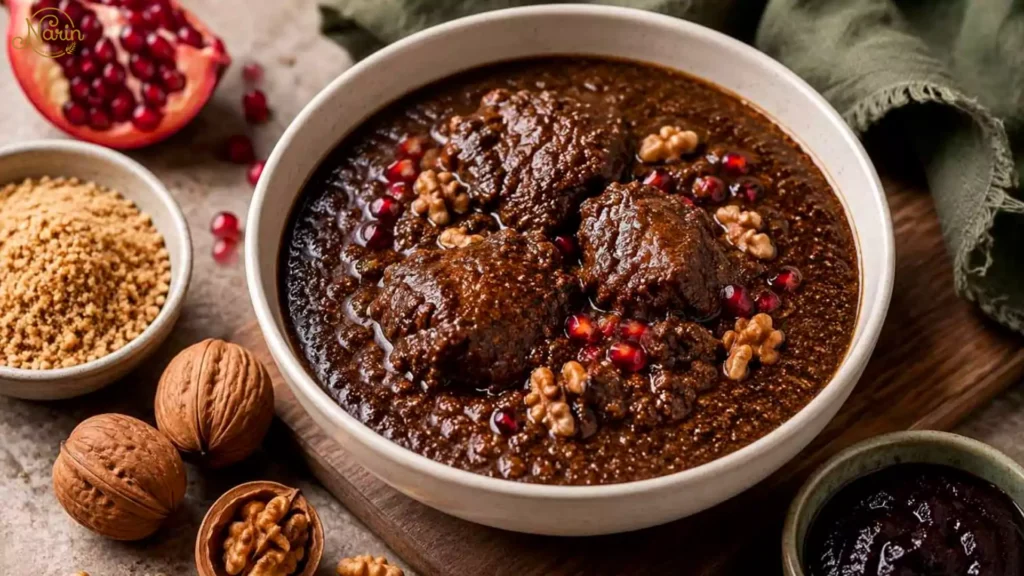
There is no single correct sweetness level for Fesenjoon. Northern Iranian styles often lean tart or sweet-sour; versions from other regions and households may be noticeably sweeter. The pomegranate product matters too. A dark, sour molasses creates a different result from a sweeter concentrate. Diners who dislike sweet main courses should ask about the restaurant’s flavour profile before ordering.
Fesenjoon should feel smooth and substantial, with finely ground walnuts forming part of the sauce rather than sitting in loose pieces. The walnut flavour should taste cooked, not raw or floury. A little natural walnut oil may appear at the surface. That sheen is common after a long simmer, but colour and oil are not reliable quality tests by themselves.
Who is Fesenjoon suited to?
Fesenjoon with chicken suits diners who enjoy fruit in savoury food, nut-based sauces, or the contrast between tart and sweet flavours. It is denser than Ghormeh Sabzi and Gheimeh, so a modest amount can carry plenty of flavour across a serving of rice. People who enjoy pomegranate molasses are likely to understand the dish more quickly than those expecting a conventional meat-and-gravy stew.
Our Fesenjoon is made with slow-cooked chicken, toasted walnuts and pomegranate molasses. Walnuts form the base of the sauce rather than being used as a garnish. If you have a tree-nut allergy, please treat Fesenjoon as a nut-containing dish and ask our team about the ingredients and possible cross-contact before ordering.
Gheimeh: split peas, lamb, tomato and dried lime
Gheimeh is a Persian stew of diced meat, yellow split peas, onion, tomato and dried lime. Thin fried potato strips are commonly added at serving time, keeping some crispness against the soft meat and sauce. Turmeric is widely used, while cinnamon, saffron and other seasonings depend on the cook and regional style.
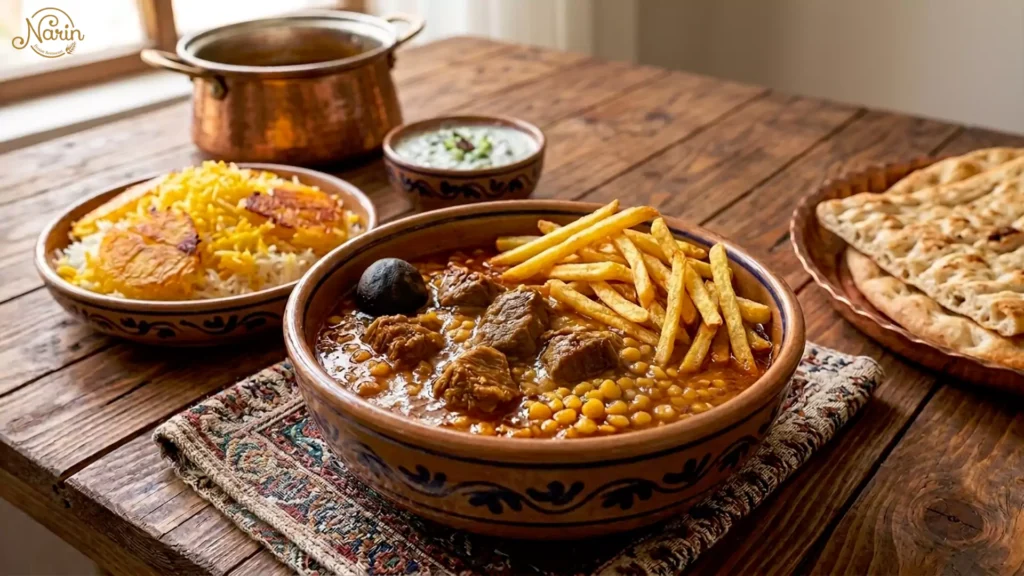
Gheimeh can be the most approachable of the three stews for a diner new to Persian food. Tomato, lamb and split peas are easy to recognise, then limoo amani gives the dish its Iranian character. The flavour is savoury and gently tart. It lacks the pronounced herb aroma of Ghormeh Sabzi and the walnut-pomegranate richness of Fesenjoon.
The split peas should be tender without disappearing into a purée. Meat needs to be soft enough to eat easily, and the sauce should taste integrated rather than like cooked tomato with separate spices. Fried potatoes work best when they retain some texture; leaving them submerged for too long can make the topping limp.
What is the difference between Gheimeh and Ghormeh Sabzi?
Gheimeh and Ghormeh Sabzi share meat, legumes and dried lime in many recipes, yet they do not taste alike. Gheimeh relies on yellow split peas and a tomato-based sauce. Ghormeh Sabzi relies on sautéed herbs and beans. Gheimeh is red or orange-brown with a distinct split-pea texture; Ghormeh Sabzi is dark green and packed with chopped herbs.
The dried lime behaves differently beside each base. In Gheimeh, it cuts through tomato and lamb. In Ghormeh Sabzi, it sits alongside fenugreek and the darker herb mixture. A diner choosing between them should think about tomato versus herbs rather than focusing only on the shared lime.
Gheimeh Bademjan: where eggplant changes the dish
Gheimeh Bademjan belongs to the same flavour family as Gheimeh but adds fried eggplant. Some recipes use eggplant in place of the fried potato topping; others arrange it beside or over the stew. The eggplant absorbs part of the sauce, bringing a softer texture and a gentle sweetness that rounds out the tomato and dried lime.
Our Gheimeh Bademjan combines split peas, lamb, dried lime and fried eggplant in a tomato sauce. You may enjoy it if you already like eggplant dishes such as khoresh bademjan or moussaka, although its flavour remains distinctly Persian. If soft eggplant is not for you, our classic Gheimeh may be a better choice.
Which Persian stew should a first-time diner order?
Choosing a Persian stew for the first time is easier if you ignore popularity and start with flavour. These dishes are different enough that enjoying one does not mean you will automatically prefer the others.
- Order Ghormeh Sabzi if you like herbs, beans, lamb and a dry citrus tang.
- Order Fesenjoon if you enjoy walnuts, pomegranate and sweet-sour sauces.
- Order Gheimeh if you prefer tomato, split peas and a familiar savoury stew.
- Order Gheimeh Bademjan if eggplant is a deciding factor for you.
- Share a stew with the table if you want to taste it beside a kebab or rice dish before committing to a full plate.
Sharing works particularly well for people exploring Persian food in Western Sydney for the first time. Two stews with different bases, such as Ghormeh Sabzi and Fesenjoon, show far more range than two dishes built around similar ingredients. For a larger group, Gheimeh or Gheimeh Bademjan adds a tomato-and-split-pea option to the table.
What should you eat with Persian stew?
Persian stew with saffron rice is the standard pairing for a reason. Chelow has a mild flavour and separate grains that take up the sauce without competing with it. The saffron portion adds aroma and colour, while the plain rice keeps each mouthful balanced. Persian stew is better treated as a sauce-rich partner to rice than as a bowl to eat on its own.
Salad Shirazi brings cucumber, tomato, onion, mint and lime to the meal. Its fresh acidity can lighten a dense Fesenjoon or a lamb-based Gheimeh. Mast-o-khiar and mast-o-musir add a cool yoghurt contrast to herbs, tomato and dried lime. Persian pickles suit diners who want more acidity, though it is sensible to taste the stew first; a tart Ghormeh Sabzi may need less pickle than a mild one.
Fesenjoon rarely needs a strongly flavoured side. Walnuts and pomegranate already give the sauce considerable weight. Plain or saffron rice lets those ingredients stay clear. Ghormeh Sabzi and Gheimeh sit comfortably with yoghurt, herbs or Salad Shirazi, depending on the stew’s acidity.
How can you tell whether a Persian stew is well cooked?
A well-cooked Persian stew should taste unified. The sauce, meat, legumes, herbs or nuts should belong in the same spoonful rather than feeling like separate components dropped into liquid. Good khoresh has enough sauce for rice, but it should not resemble soup.
Each stew has its own useful checks:
- Ghormeh Sabzi should not taste of raw herbs, burnt greens or tough meat.
- Fesenjoon should have a thick walnut sauce without a raw, floury nut flavour.
- Gheimeh should have cooked split peas that remain visible rather than collapsing completely.
- Fried potato on Gheimeh should keep some bite when it reaches the table.
- Eggplant in Gheimeh Bademjan should be soft without leaving the sauce excessively oily.
Thickness is only one clue. A stew reduced too far can become heavy and difficult to mix with rice; a thin stew can taste weak or disconnected. Tender meat, a clear main ingredient and controlled acidity say more about the cooking than darkness or surface oil alone.
Are Persian stews spicy, halal or gluten-free?
Persian stews are generally aromatic rather than chilli-hot. Turmeric, saffron, cinnamon, herbs, dried lime and pomegranate create flavour without the heat found in a chilli-led curry. English speakers sometimes use “spicy” to mean either hot or strongly seasoned, so it helps to ask whether the question is about chilli heat or spices.
Our Fesenjoon is made with slow-cooked chicken, toasted walnuts and pomegranate molasses. Walnuts form the base of the sauce rather than being used as a garnish. If you have a tree-nut allergy, please treat Fesenjoon as a nut-containing dish and ask our team about the ingredients and possible cross-contact before ordering.
All four Persian stews currently on our menu contain meat, and our Fesenjoon also contains walnuts. If you are vegetarian, vegan or managing an allergy, please check each dish description and speak with our team rather than relying on the words “Persian stew” alone. Recipes differ between kitchens, and our menu descriptions reflect the way we prepare each dish at Narin.
Persian stews at Narin in Northmead
If you are looking for Persian stew in Sydney, our Stews & Khoresht menu includes four options: Ghormeh Sabzi, Fesenjoon, Gheimeh and Gheimeh Bademjan. We are a Persian restaurant in Northmead, close to Parramatta, serving these stews with saffron rice alongside our kebabs, mixed rice dishes and starters.
The four dishes cover three very different bases: herbs and beans; walnut and pomegranate; or tomato and split peas. That range is useful for a mixed table because guests do not need to agree on one flavour profile. One stew can be ordered as a main, or several can be placed in the centre with rice and other dishes to share.
Check Narin’s Persian food menu for current dish descriptions and allergen symbols before visiting or ordering takeaway. Guests with a serious allergy or dietary requirement should confirm the latest preparation details directly with the restaurant, as recipes and kitchen procedures can change.
The quickest way to choose between the three stews
Ghormeh Sabzi, Fesenjoon and Gheimeh show why “Persian stew” is a broad menu category rather than one flavour. Ghormeh Sabzi is led by herbs, beans and dried lime. Fesenjoon turns walnuts and pomegranate into a thick sweet-sour sauce. Gheimeh uses split peas, lamb and tomato for a more familiar savoury base, while Gheimeh Bademjan adds the soft texture of eggplant.
Choose by flavour rather than reputation: herbs and tartness point to Ghormeh Sabzi; walnuts and pomegranate point to Fesenjoon; tomato and split peas point to Gheimeh. If the names still feel unfamiliar, share two contrasting stews with rice. A few spoonfuls side by side will explain the differences more clearly than any ranking.
Frequently asked questions about Persian stews
What is the best Persian stew for a first-time diner?
Gheimeh is approachable for diners who like tomato-based meat stews. Ghormeh Sabzi suits herb and citrus flavours, while Fesenjoon is better for those who enjoy walnut and pomegranate sauces.
What is the difference between Ghormeh Sabzi and Gheimeh?
Ghormeh Sabzi uses sautéed herbs, beans, meat and dried lime. Gheimeh combines yellow split peas, meat, tomato and dried lime, commonly finished with fried potato strips.
Is Fesenjoon sweet or sour?
Fesenjoon can be tart, sweet-sour or mildly sweet. Its flavour depends on the pomegranate molasses and the regional or family recipe, so ask the restaurant how its version is balanced.
Are Persian stews hot and spicy?
Most Persian stews are fragrant rather than chilli-hot. Ghormeh Sabzi, Fesenjoon and Gheimeh draw their character from herbs, turmeric, dried lime, saffron or pomegranate rather than strong chilli heat.
Does Fesenjoon contain nuts?
Yes. Ground walnuts form the base of Fesenjoon sauce. Guests with a walnut or tree-nut allergy should ask about ingredients and cross-contact before ordering.
Can I order Narin’s Persian stews for takeaway or a group meal?
Narin lists dine-in, takeaway and catering among its services. Check the current menu and contact the restaurant directly for dish availability, larger orders and group booking arrangements.
Where is Narin Persian Restaurant, and what should I know about parking?
Narin is at 14/2B Campbell Street, Northmead NSW 2152, near Parramatta. Parking and access conditions can change, so contact the restaurant for current advice before travelling with a group or a guest who has mobility needs.